Continuing the data collection exercise, the research team engaged fisherfolk in the Greater Accra Region in the second week of July deploying survey (questionnaires), key informant interviews (KII), focus group discussions (FGD) and ethnographic observations. From 8 to 10 July 2024, the team was in Akplabanya, one of the major fishing communities in the Ada West District, to interact with the fisherfolk. The Akplabanya community is bounded by the Akplaba Lagoon and large salt pans.
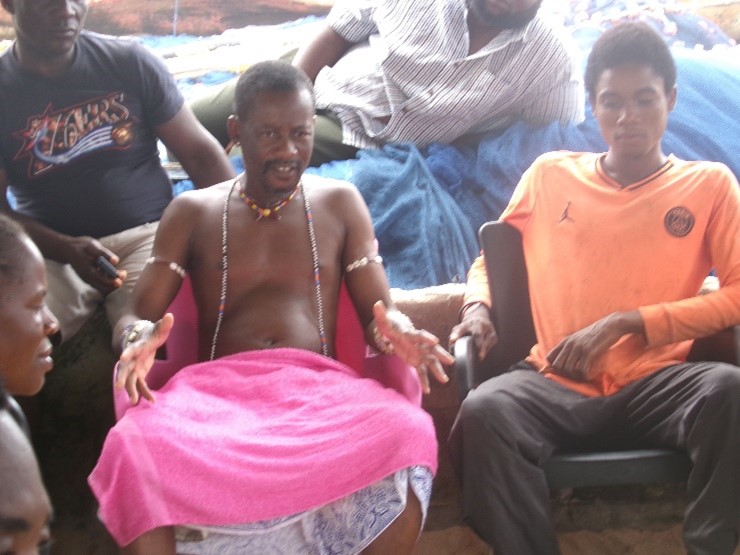
Upon entry into the community, a courtesy call was first made on the Chief of Akplabanya, Nene Kitcher VI. The Chief warmly received the team and upon hearing the team’s mission, gave his approval for their activities in his community. The courtesy call was a symbolic recognition of Nene’s role as the traditional head of the community, who by customary norms needs to be asked permission before carrying out any activity in his territory. The Chief was later engaged in a KII and he shared fascinating information about historic indigenous practices and his perspectives to the gendered impact of the fishing closed season policy on his community members. The team made another courtesy call on the representative of the Chief Fisherman in the community; the Chief fisherman in his leadership role attends to the affairs of fisherfolk within the jurisdiction of his landing beach.


In general, the community was observed to be complying with the closed season policy. Canoes were lined up in formation at the shore and fishers grouped into companies of crews intently mending their nets or repairing their canoes. Commercial activities of food vendors and input dealers along the beach seemed to be ongoing albeit at a slow pace. The fishing input shop which sells ropes, twines and other additional materials used for fishing gears was open daily for business; the outboard motor repair shop was seen opened once during the three days spent in the community. In conversation, the service providers shared with the team that their businesses have been greatly impacted by the closure as the patronage from fishers has reduced significantly due to low cashflow in the community. Some children of school-age were seen engrossed in a game of table soccer. When asked, “why are you not in school on a weekday?”, they responded in unison that their parents had told them there was no money for them to go to school because of the closed season.


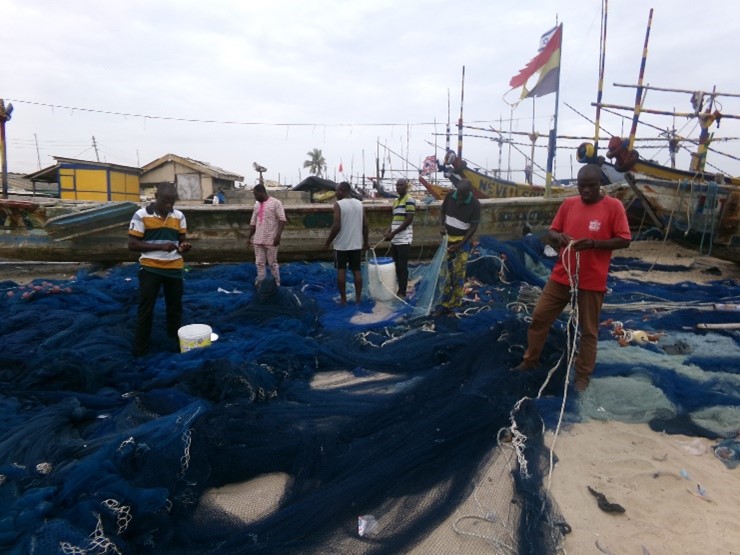
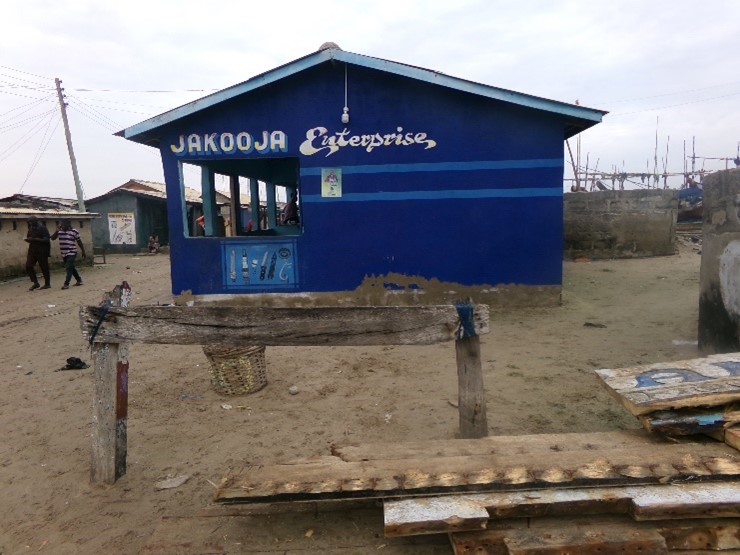

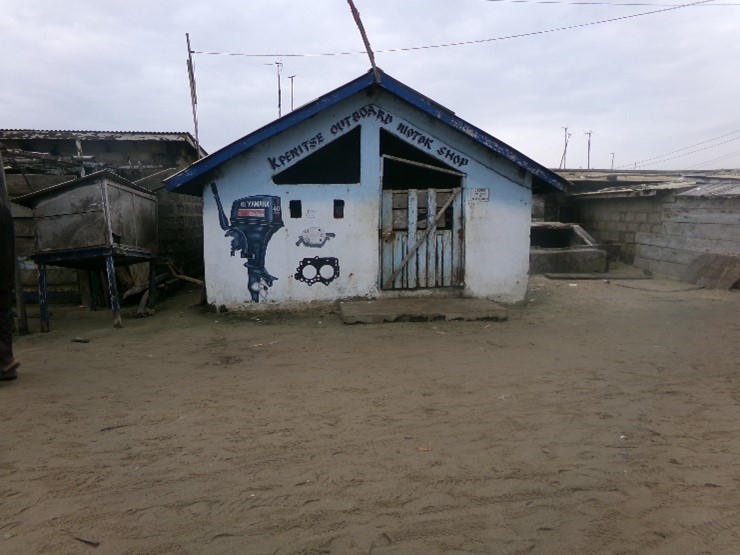
The representative of the Chief fisherman, women’s president of National Fish Processors and Traders Association (NAFPTA) and African Confederation of Professional Organisations of Artisanal Fisheries (CAOPA), assembly man, opinion leaders in the community were engaged in key informant interviews where they shared rich personal insights in relation to the questions asked. The assembly member, volunteer translators, alongside local collaborators CaFGOAG played an immense role in supporting the team’s work in the community towards a successful end.


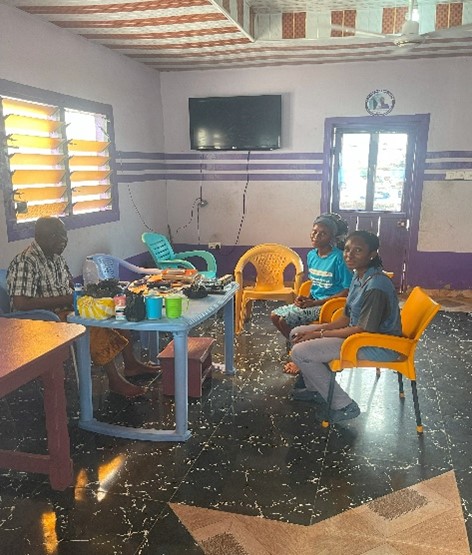
Progressing with data collection, the team moved on to engage fisherfolk in the Tema (canoe basin) from 11 to 13 July 2024. Tema (canoe basin) is a cosmopolitan fishing hub in the Tema Metropolitan Area, adjoining the fishing harbour, and in vicinity with the cargo port and an industrial area. The catchy sights at Tema were the multi-coloured fleet of canoes docked in the wharf with their different flags waving in the breeze. Additionally, different species of fish (thawed from frozen) were on display with their sellers eagerly approaching oncoming persons with beseeching to patronise their fish. There was also the display of input items like twines, ropes and floats, food vendors hawking different types of food to the harbour patrons and customers carrying cartons of frozen products from cold stores.
The net mending sheds were chock-full of nets with companies of crew members intently mending, patching up and replacing worn-out portions of their nets. The commercial setting of Tema was noted to be more lively compared to previous fishing communities visited for the data collection, however the level of activity seen in Tema is lower than its usual pace of activities that could be observed during an active fishing day. Located outside the fishing habour is the European fish market where the sale of different species of frozen fish was thriving – customers (white foreigners and Ghanaians) parked in fluid succession, one after another, to patronise from their fish suppliers.

Male fish trader displaying his fish to oncoming patrons of the Tema fishing harbour 
Canoes berthed in Tema in compliance with the closed season 
Array of fresh fish traders (women) in Tema displaying their produce and hailing customers 
Cartons of frozen fish being transported by a customer from a cold store located in Tema 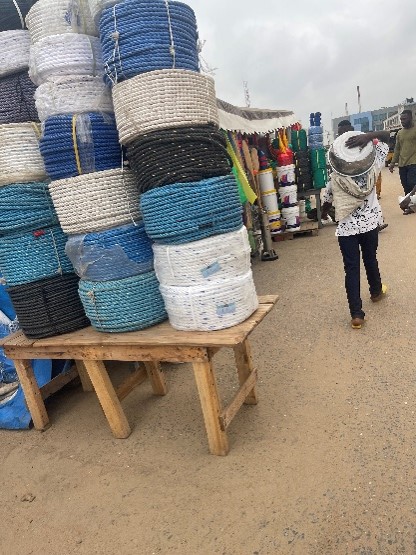
Fishing input shop with different types of ropes and other fishing input on display at Tema 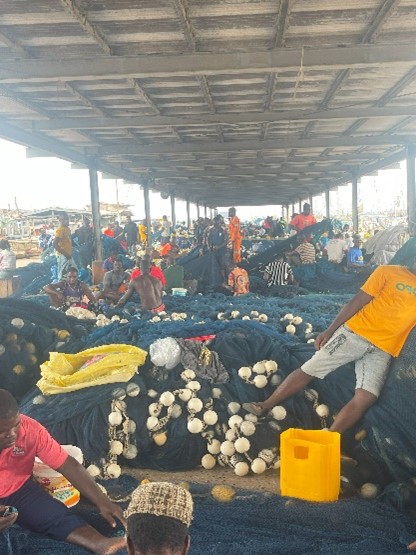
Heaps of fishing nets under a shed at the Tema canoe basin with fishermen working on them
The chief fisherman of Tema, the leadership of fish traders of the European market and other opinion leaders were receptive to the team’s engagement and helped mobilise other fisherfolk for the team to interact with them. Despite male and female fisherfolk busily carrying out their respective activities, they were very welcoming to the research team and shared insights about indigenous practices and their personal perspectives about the closed season policy.


The research team led by Dr Ifesinachi Okafor-Yarwood and comprised of Nana Kweigyah and Kenneth Arthur (Canoe and Fishing Gear Owners Association of Ghana – CaFGOAG), Emmanuel Tenkorang (Fisheries Committee of the West Central Gulf of Guinea – FCWC), Mr Kwesi Johnson (Local Consultant and Research Field Supervisor; Freelance Coastal Marine Fisheries Sustainability Community Development Practitioner), Gabriel Mevuta (co-opted volunteer from Friends of the Nation) and Josephine Laryea Asare (PhD researcher – University of St Andrews) express their appreciation to all fisherfolk and stakeholders in the Greater Accra Region whose contribution made the data collection exercise in Akplabanya and Tema (canoe basin) a success! Appreciation also goes to the research collaborators – the Fisheries Commission, CaFGOAG and the FCWC, for their efforts towards a fruitful data collection in Akplabanya and Tema (canoe basin). The team wishes to acknowledge the Pew Fellows Program in Marine Conservation at the Pew Charitable Trusts, whose funding made this research project possible. The research team, having concluded activities in the Greater Accra Region, headed to the Central Region to engage fisherfolk in Apam and Cape Coast.